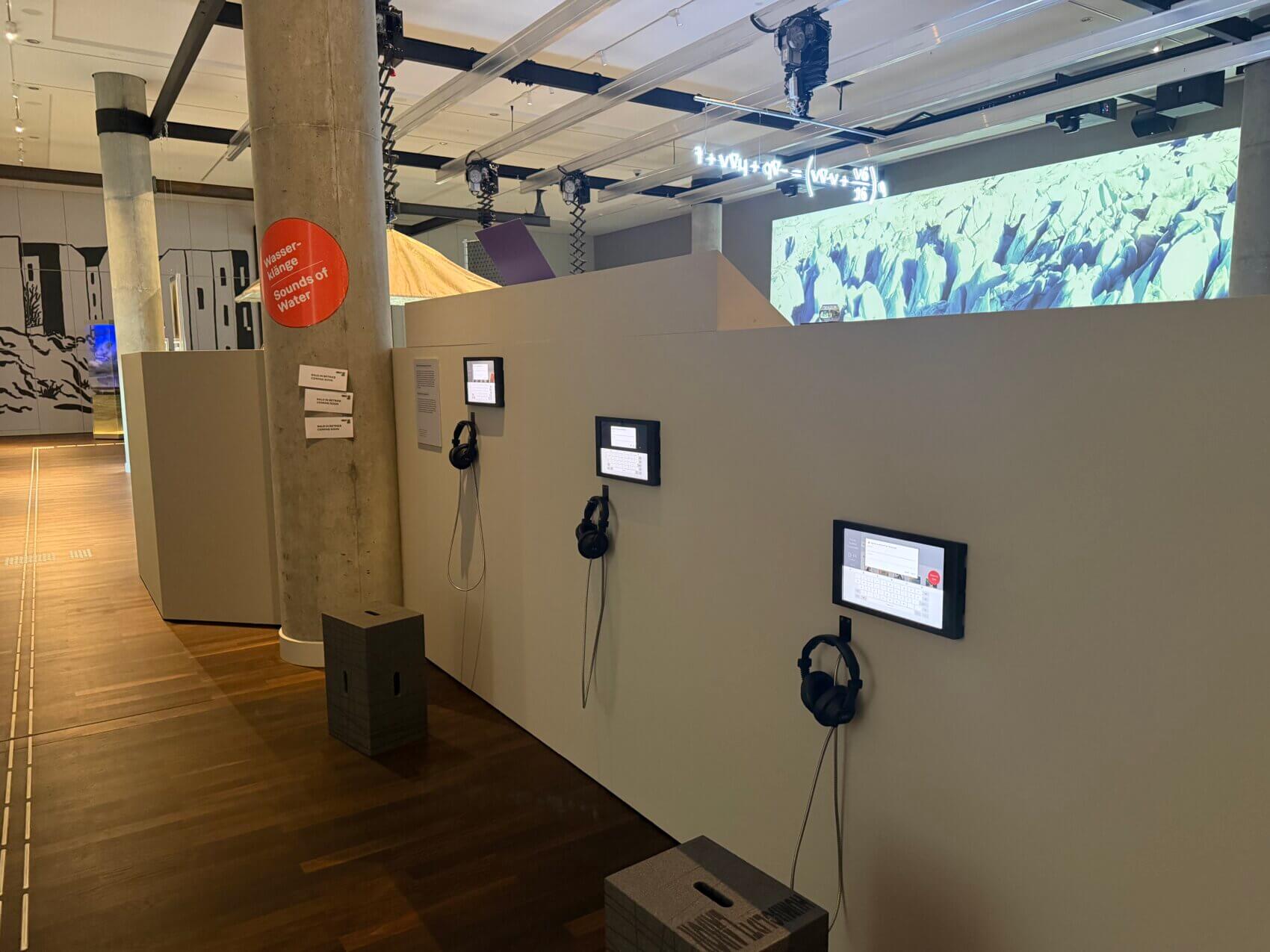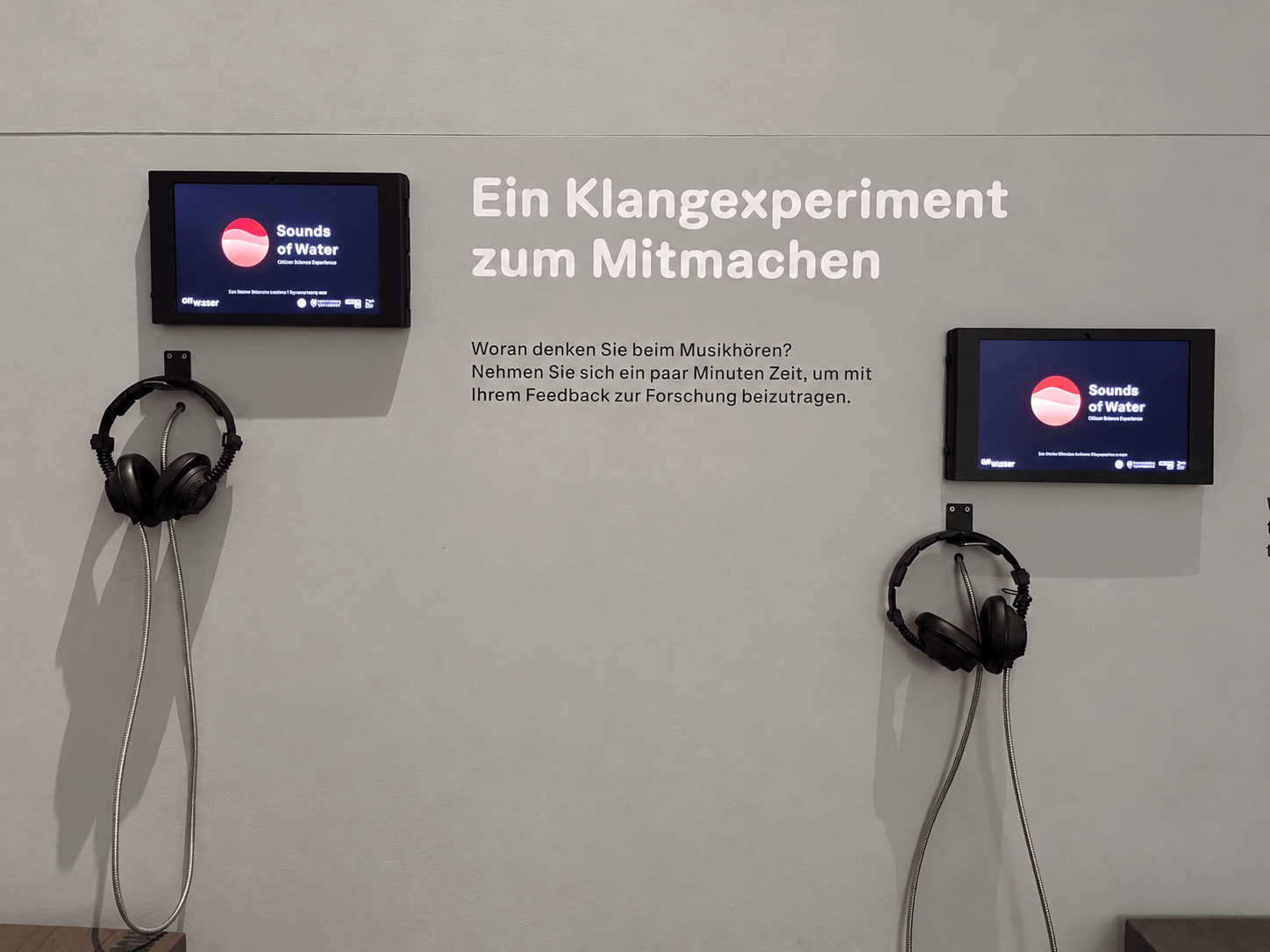
What do we see in our mind’s eye when we listen to music? And to what extent is this influenced by what others have heard before us? These are the questions explored by the digital station “Sounds of Water” in the exhibition “On Water. WaterKnowledge in Berlin.” The citizen science game is a collaboration between Humboldt-Universität zu Berlin and Princeton University. At Princeton, the project is led by Prof. Dr. Elizabeth Hellmuth Margulis, who directs the Music Cognition Lab in the Department of Music. The German project partner is musicologist Prof. Dr. Mats Küssner. At the start of the project, he was a research associate at Humboldt-Universität zu Berlin. He is now Professor of Applied Musicology at Gustav Mahler Privatuniversität in Klagenfurt. The response has been tremendous: Between mid-April and the end of September 2026, the game was started more than 3,400 times, with approximately 2,350 sessions completed.
Listen, Describe, Evaluate
At three tablets in the exhibition space, the game begins by asking participants to provide a few details about their age, gender, nationality, and country of residence. They then listen to short excerpts of music. After each excerpt, participants describe in their own words the images, scenes, or stories the music evokes in their minds. They also indicate how much they like the piece and how familiar it is to them. There are no right or wrong answers; participants can also indicate that they did not imagine anything while listening. The station is bilingual: Around 60 percent of participants played the game in German, while the remainder chose English. A complete session takes an average of four to five minutes, and approximately two-thirds of visitors play through to the end.
Listening Alone or in the Echo of Others?
Behind the playful format lies an experiment. Some visitors listen to the music without external influences, looking at a neutral, dark screen. Others see a word cloud while listening, displaying terms that previous participants used to describe the same excerpt. By comparing the two groups, the researchers aim to determine whether, and to what extent, other people’s mental images influence our own. Participants find out which group they belonged to afterward. On a results screen, they can explore the descriptions provided by all previous participants and filter them by age, gender, or nationality. A music library then invites them to continue listening.