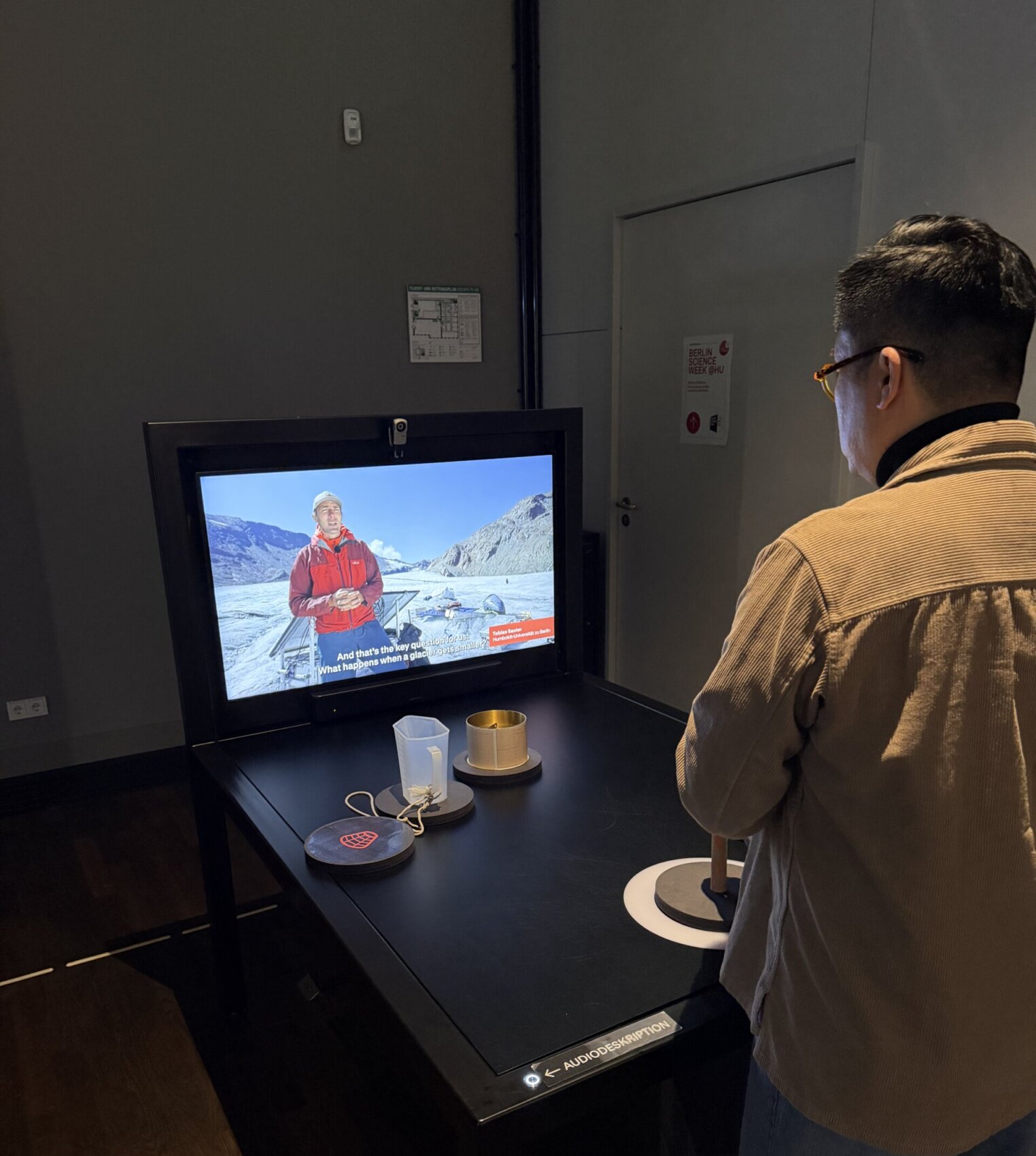
Visitors imitate a hand movement made by the researchers to discover the films. What does this physical, playful approach change?
I thought your idea for the station was incredibly good, precisely because it is so simple. A gesture creates a connection. By imitating it, you engage with your own body while exploring a movement taken from the researchers’ work. It sparks curiosity, and you are no longer just watching passively.
I like how small and manageable it is. It is playful, which also reflects my own approach. The movement is easy to understand, regardless of someone’s age or where they come from.
At the same time, it already communicates something about science: Research is not just about sitting at a desk and writing. There is much more to it. The gesture opens a door to that wider world. It builds a bridge that is often missing from conventional science films.
As the person who came up with the concept, I’m naturally glad to hear that. But back to the visitors: What do you hope they take away from watching a film?
I want them to feel they have experienced something. Of course, they might also have learned a figure or understood a connection. But it is equally important to me that they sense the atmosphere and the researchers’ enthusiasm for their work—and see the different places where research happens.
For one film, for example, we went to an algae farm in Kiel and also filmed underwater. Ony Yan had designed and developed a prototype system intended for algae to grow on. It had been in the water for months. She did not know beforehand how much algae had actually grown on it. We were there at the exact moment it was pulled out of the water.
We held the algae in our hands, laughed, and shared the joy of seeing the result. Those are the moments I want to communicate. And the collaborative work, too, as on our cycling excursion with Christian and the group of students.
In a way, science is a journey: You begin with a research question, but you do not yet know the answer. There are milestones along the way and always something new to discover.
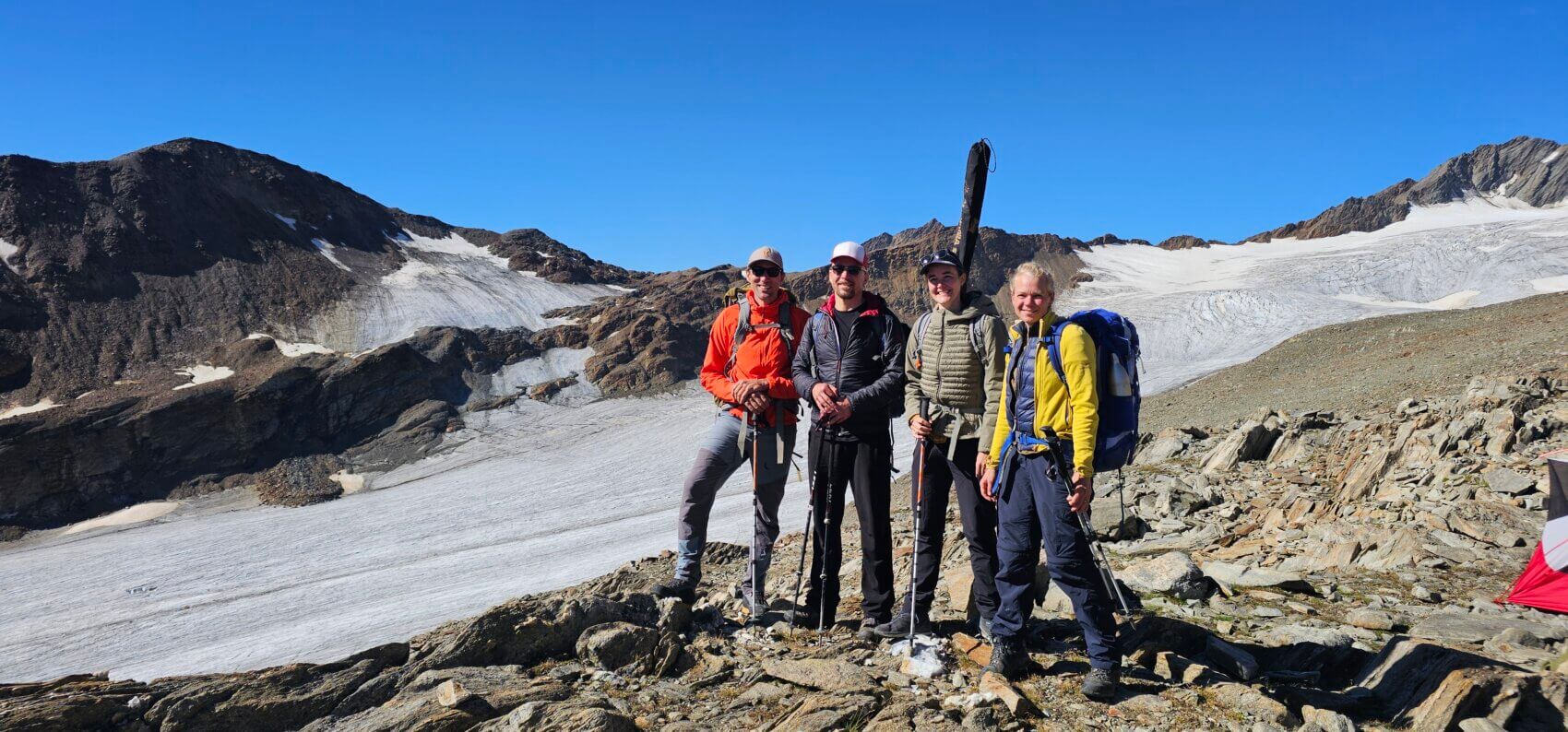
That was apparent on the glacier as well. When we arrived, Tobias’s doctoral researchers had already set up the equipment. Just imagine what it takes to plan and accomplish something like that on a glacier! Tobias was delighted by how precisely and skillfully they had worked. You could sense that he had a team around him he could rely on.
I wanted to tell that part of the story as well: everything it takes for research to succeed, how people collaborate, and how they celebrate their findings.
How do you see these science films fitting into the rest of your work?
For me, it was a wonderful assignment. I studied Gender Studies and Latin American Studies at Humboldt University and earned my Magister degree. So I know academia from many years of experience. Combining that background with the work I do today was a wonderful challenge. I could do something like this every day.
It did not feel like a side project to me, but like a very natural fit. I bring a playful and sensory style from other areas of my work. Translating that into science films was a great combination.
My collaboration with you, Tom, actually began earlier. After I had spent four years producing and also visually developing cooking shows for Deutsche Welle, you approached me from the Berlin University Alliance. You asked whether we could develop a science cooking show together that would enable the exchange of knowledge.
Since then, at the latest, I have been deeply engaged with science communication. How can you build a bridge to scientific findings that initially seem dry or difficult to access? With the cooking show, our idea was to cook and talk about a scientific topic at the same time. The challenge comes from bringing those two things together. There is no need to force the humor.
Similar questions arise in the book trailers I regularly make for Suhrkamp Verlag, including one I am working on right now. How do you tell the story of a book in a short film? Which passages do you choose? I work with the authors to do that. I am interested in how content can be translated into stories that people can experience visually.
I deliberately work across different fields: for Deutsche Grammophon, for Rosenthal for many years, and across music, literature, design, art, food, dance, and science communication. I have also undertaken further training in systemic coaching, design thinking, systemic design, and leadership, as well as in somatic practice—specifically, Fluentbody. All of these experiences feed into my work.
I want my films to do more than simply fulfill a brief. In “Catching the Big Fish,” David Lynch describes how the big ideas lie in deep water. I like that image: diving in first, even into the unknown, and then resurfacing with ideas. Playfully and with an open mind.
Has the work also inspired you to pursue new projects in terms of subject matter?
Yes. Above all, I cannot stop thinking about water. At the “Confluence of European Water Bodies” in Berlin, I met many people from research and other fields again, including Léon Gross from the Symbiotic Lab. I am also currently working on a documentary film about water in Brazil. It is an incredibly important subject.
I am especially interested in what science can contribute not only to public debate but also to putting sustainable, future-oriented concepts into practice. We need these scientists. They are visionaries, too, because they engage deeply with things many people have not even heard of yet.
We talked a lot about the climate crisis during filming—including the possibility that the Hintereisferner glacier could disappear by the end of this century. How does engaging with these issues translate into action in your own life?
I started the YouTube series “People for Change” on my own initiative. Reading Donna Haraway also played a part in that. I kept asking myself: Where are the levers for change? Why is so little happening? What is holding us back?
I noticed how surrounded we are by negative messages. When we talk about the climate, it is usually about the crisis. How could we tell that story differently? There are so many people already doing wonderful things whom we can learn from—including in science.
I visit these people and talk to them. For example, I interviewed Jennifer Schulz, who initiated and developed the “Urbane Waldgärten” (“Urban Forest Gardens”) project and the forest garden in Berlin-Britz together with her team. This pioneering project in the middle of the city shows how plants, animals, soil, and water interact. Nothing grows in isolation. I find that a fascinating achievement.
I am interested in people who combine knowledge with commitment and actually bring projects to life. Examples like these show that implementation is possible—and give us something to learn from. Many people would like to get involved but do not know how. “People for Change” presents concrete opportunities, such as supporting the BaumEntscheid Berlin initiative, which is looking for help.
What does that mean for the way we deal with water here in Berlin?
When you engage with the exhibition and the research, you realize that clean drinking water from the tap is not something to take for granted. In many countries, it is not available.
We stood with Christian in Humboldthain park, looking out over the city. His first question was, “What do you see?” Greenery! It reminded me once again how important green spaces and a functioning water cycle are for the city. Berlin’s drinking water comes from groundwater and bank filtration—that is, water that seeps from rivers and lakes through the soil and is naturally filtered in the process. It is treated at the waterworks but requires no added chlorine. Madrid, by contrast, uses chlorine compounds, among other things, for disinfection. Such differences show how much goes into our everyday water supply.
This is not just a responsibility for science, but for all of us. We have to engage with these issues and ask what we ourselves can do. For example, the “Rights of the Spree” initiative advocates for the Spree River. I would like to get involved there, too.
At “Confluence” at the Floating University, you also explored how bodies of water might be given a voice. What interests you about that?
That is where I encountered the term “waterbody”: Bodies of water were represented by people who had traveled from different countries. I spoke with the Italian campaigner Roberta Bosu, who represented Antarctica. The idea is to think beyond our human perspective and give bodies of water a voice.
In Spain, the Mar Menor lagoon and its catchment area were granted legal personality and rights of their own in 2022. That goes beyond conventional nature conservation: An ecosystem itself becomes a legal subject. Companies can be legal persons—so why should we not grant bodies of water rights of their own? I find approaches like these very exciting.
If you could give Antarctica the floor to close our conversation, what would it say?
That is a fascinating question because it challenges us not to see, act, and judge solely from a human-centered perspective, but to try to put ourselves in the place of bodies of water. I do not know if I can answer it yet, but I want to explore it further.
Antarctica does not have a voice of its own that we can hear. It needs our voices. Rivers need us, too, to stand up for them.
Much is still intact; that richness is still there. And some people believe they can become rich by destroying precisely that richness.
Link to the Perola Filmes website and its YouTube channel.