Magazine
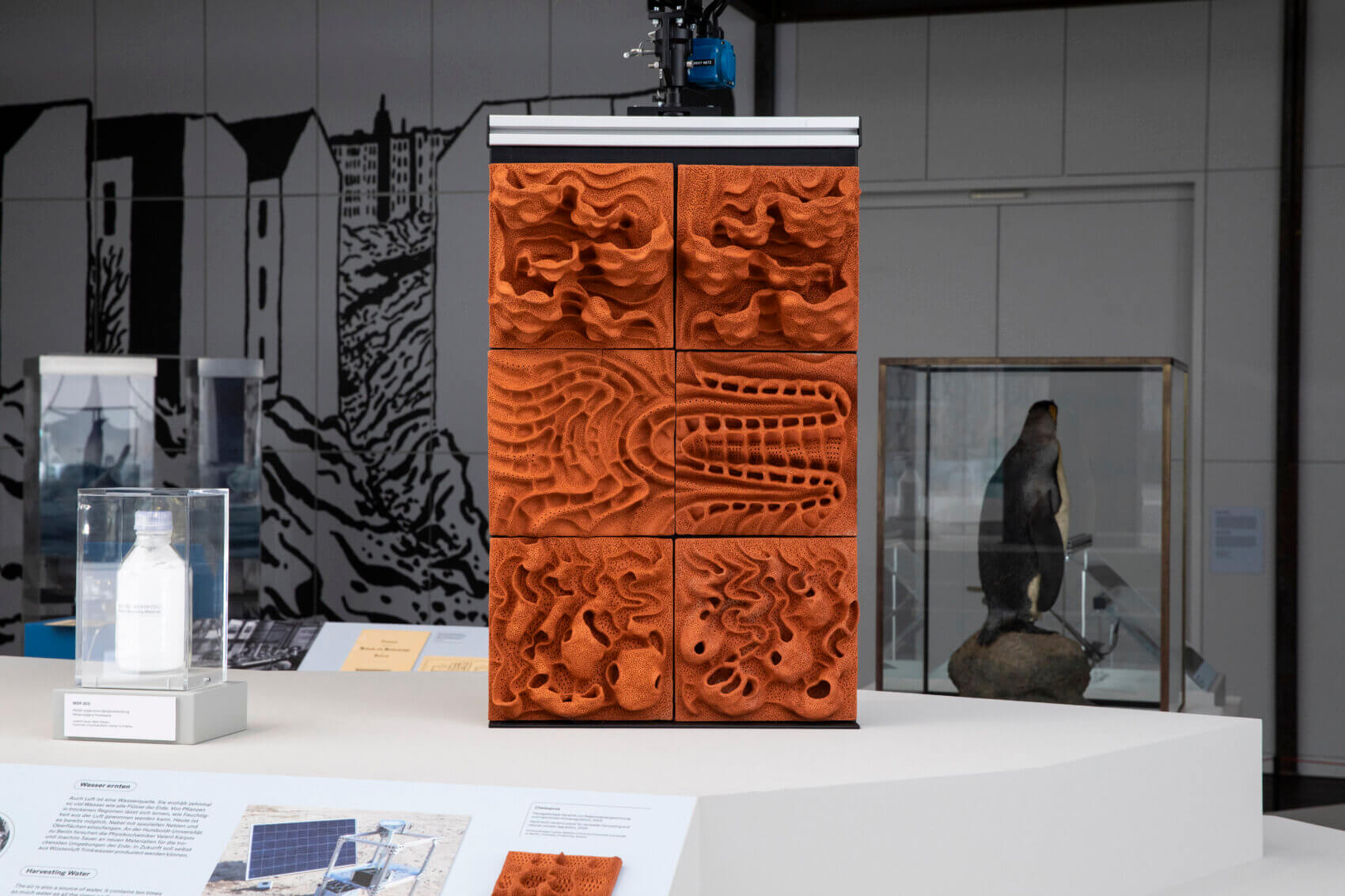
Ausstellungsansicht mit Keramik im Zentrum, außerdem Flasche mit MOF-Pulver links davon. Im Hintergrund ist ein Wandmotiv von Werner Heldt zu sehen

© Foto: Michelle Mantel, Copyright: Matters of Activity

Beyond the Object: Exploring Water, Clay, and Collective Making with Dimitra Almpani-Lekka

In the On Water. WasserWissen in Berlin exhibit at Humboldt Labor, architect and researcher Dimitra Almpani-Lekka presents Cheimarros, a ceramic installation that explores how architecture might actively harvest, circulate, and share water within urban environments. Rather than proposing a finished technical solution, the work functions as an experimental system that investigates the relationship between buildings, water, and more-than-human life. As Almpani-Lekka explains, “Cheimarros is a ceramics installation that explores vertical water harvesting, absorption, and circulation as a means of addressing urban water management, climate regulation, and the support of urban biological growth.”

The prototypes, she says, “serve as a method of asking questions, revealing challenges, and evoking empirical knowledge on how water interacts with, shapes, and is shaped by its landscape.”

The project grew out of both architectural research and an open-ended process of making by hand. Working with clay allowed Almpani-Lekka to test ideas directly through the material, despite having no formal training in ceramics. “It has potentially been helpful that I have no training in working with clay,” she reflects, “so I started experimenting with no technical skills, a need to problem-solve and a great openness to learn.” Through this process she discovered “elements of playfulness, discovery and inventiveness,” while asking whether there were lessons that could only be learned through making. “The answer was luckily yes.”

Ceramic became the project’s material not only because of its versatility, but because of its intrinsic relationship with water. “Clay and ceramics, as porous materials, have a direct relationship with water, as they can absorb and distribute it within them, filter it and release it back into the atmosphere,” she explains. At the same time, she is careful to acknowledge the material’s limitations. “There rarely, if not never, are perfect materials for any design endeavor,” she says. “Every choice you make includes negatives that you have to find ways to deal with, hopefully clever ways, that respect the material itself.”

Although Cheimarros appears as a sculptural installation, Almpani-Lekka understands it as part of a much larger network of relationships. “In my mind, everything is a system, or a part of a system that interacts with other parts within a larger system,” she says. “Material things are never just there, doing nothing. There is always some interaction taking place with their environment.” Conceived as “a fragment of a landscape system,” the installation reflects her interest in creating architecture that hosts ecological processes rather than simply enclosing space.
© Foto: Michelle Mantel, Copyright: Matters of Activity

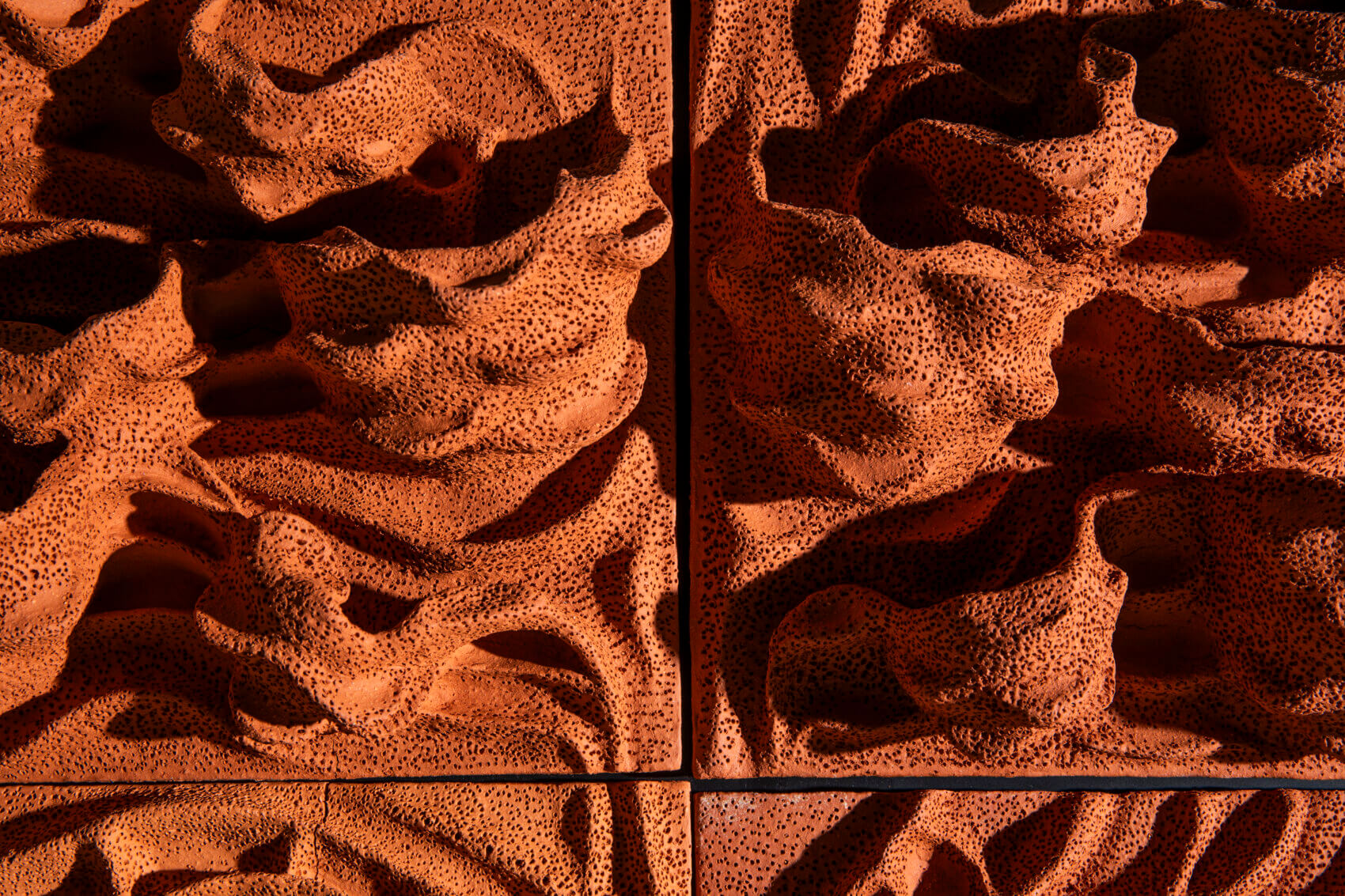
Close-up of Cheimarros: The porous ceramic structure is designed to absorb, distribute, and release water.

The opportunity to present Cheimarros in On Water emerged through a conversation with the exhibition team. “I was approached by the technical curator of the Humboldt Labor, Max Illner, when he saw some of my clay pieces at the [Matters of Activity. Image Space Material] cluster’s website,” Almpani-Lekka recalls. “We had a discussion and I was really intrigued by the different themes that they had thought of.” The exhibition’s section “On Dry Land” particularly resonated with her research, inspiring her “to produce a larger-scale piece for the exhibition that would not be a demonstration of a technical solution, but something closer to an infrastructural artwork.”

This way of thinking also informs her approach to infrastructure. Rather than concealing water systems within buildings, Almpani-Lekka argues for making them visible. Exposed infrastructure can improve maintenance and provide water for other species, but it also changes how people relate to the resources they depend upon. “As we currently rely on centralized infrastructural systems, we tend not to inquire or think about how resources become available to us,” she says.

“Physically distancing ourselves from the resources that we depend on makes us more careless in the way that we consume them. Out of sight, out of mind.”

At the same time, she believes that revealing these systems “creates a playfulness and provokes a curiosity that enriches the way we experience buildings.”

For Almpani-Lekka, Cheimarros is ultimately an invitation to reconsider our relationship with water. She hopes visitors first recognize the urgency of the present moment: “Things are not fine, and just because most of the anatomy of the infrastructure that brings clean water to our faucets is buried and invisible to us, it doesn’t mean that we are not in a crisis.” Yet she also hopes the exhibition leaves audiences with a sense of possibility. “I hope that guests leave hopeful,” she says, “and feel more empowered to do small acts and even build small interventions or practices in their neighborhoods that save and provide water in solidarity with other citizens and other species.”

Looking ahead, Almpani-Lekka sees resilience as the ability to design systems that can continually respond to changing conditions. “Resilience in the future means to design and create self-sustaining systems that rely on material and biological intelligence,” she explains. “If you create a system that is designed to learn how to adapt to the environmental changes, then the system is theoretically ever-adapting. I think that this is the definition of resilience.”

If visitors leave the exhibition remembering one thing, Almpani-Lekka hopes it is simple:

“There is great knowledge stored in natural systems.”