From the Series: “Object Stories: Meet the Team”
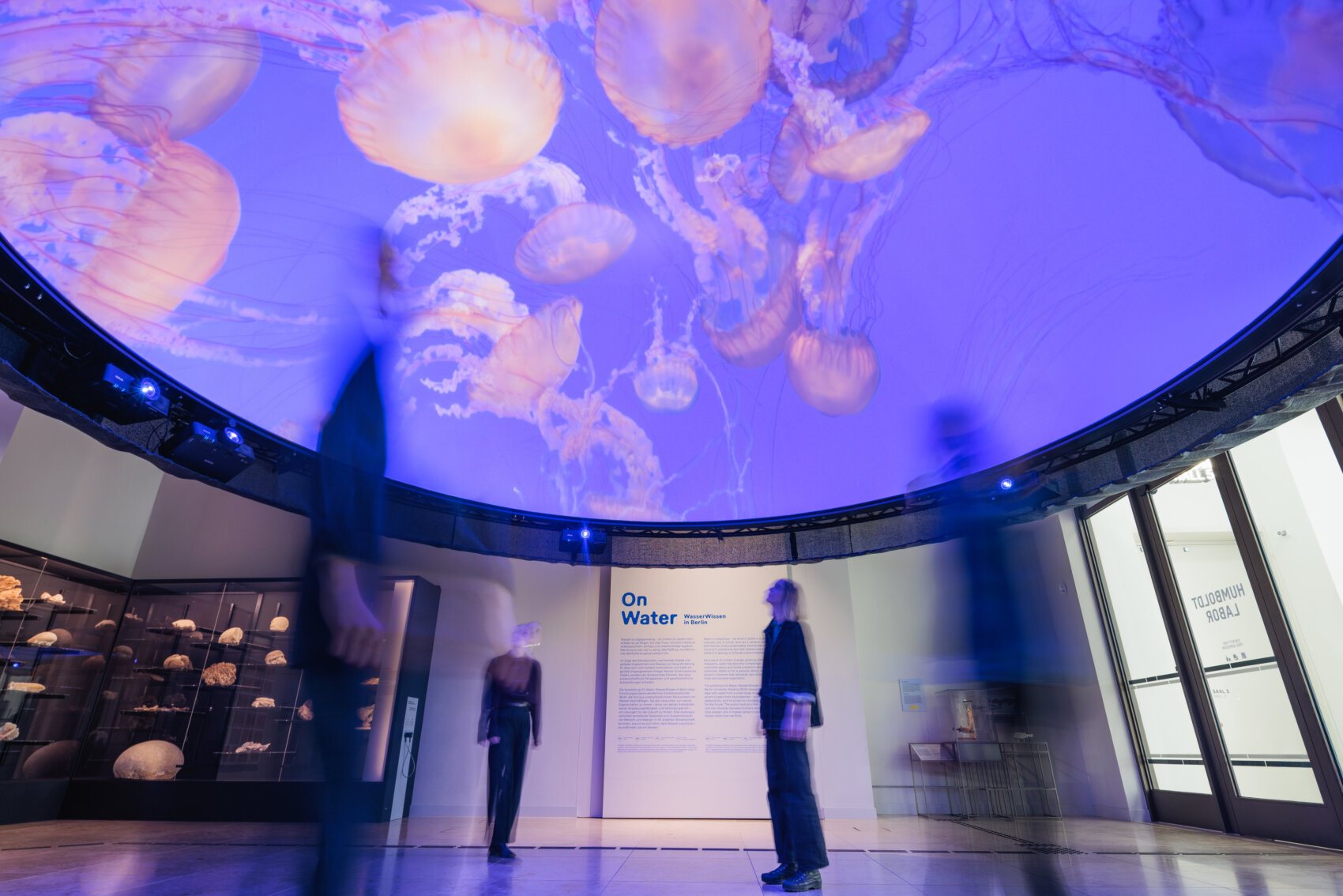
For Caspar Pichner, the dome projection of compass jellyfish, featuring footage from the Monterey Bay Aquarium, is one of the most striking exhibits in “On Water. WasserWissen in Berlin”. Their almost hypnotic, fluid movements are not only reminiscent of the gentle currents of the sea: with a water content of up to 99 per cent, jellyfish themselves can be described as ‘organised water’. Yet it is not just their appearance that fascinates the Humboldt Labor’s scenographer: “What I find particularly fascinating is how they are organised through their decentralised nervous system. Although these cnidarians are, in a sense, made of water, their distributed sensory organs allow them to ‘feel’ and even learn.”
Jellyfish have inhabited the oceans for around 670 million years, and their remarkable ability to adapt to a wide range of living conditions makes them of great interest to researchers. At the same time, their ever-changing, permeable bodies symbolise fluid identities and queer ways of thinking that challenge seemingly fixed boundaries and clear-cut categorisations. This idea of permeability is also reflected in Caspar Pichner’s scenography, which brings together different forms of sensory perception. Alongside the visually striking dome installation, tactile objects and audio stations offer visitors a variety of ways to experience the exhibition through touch and sound. Much like the jellyfish, visitors are encouraged to move freely through the exhibition space, perceiving and exploring their surroundings with all their senses. This is one of the reasons why the scenographer considers the jellyfish projection an ideal way to begin or end a visit to the exhibition:
“The dome installation creates a unique sense of immersion. It is reminiscent of a planetarium, but instead takes us beneath the water’s surface, allowing the jellyfish to float above us like celestial bodies.”
